
Heroic Modes & Strategy
What I Learned from David Kantor

Source: Roger L. Martin, 2026
I am a big fan of organizational theorist, Karl Weick, who argued that when it comes to models, it is more important to be useful than perfect. I have always attempted to build models that are useful, and happily the Strategy Choice Cascade and the Strategic Choice Structuring Process seem to be useful to a wide variety of people. In addition to building, I also enthusiastically adopt models, including those of Aristotle, John Dewey, Charles Sanders Peirce and Chris Argyris. But another is from family therapy innovator (the late) David Kantor, whose Heroic Modes model is the subject of this Playing to Win/Practitioner Insights piece called Heroic Modes & Strategy: What I Learned from David Kantor. And as always, you can find all the previous PTW/PI here.
The Heroic Modes Model
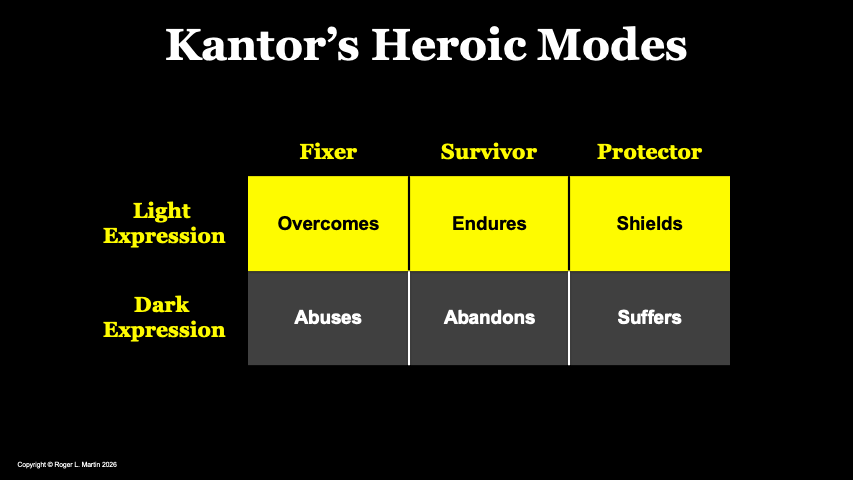
Kantor posited that human beings operate across three heroic modes, with one being their dominant or default mode. That is, when the going gets tough, we instinctively default to that mode, even though at other times we operate based on one of the two other modes. Kantor’s view is that we adopt our dominant mode early in life and it shapes our experiences of and reactions to life. He further posited that each has a light side — i.e. the productive manifestation of the mode — and (in an accidental Star Wars reference) a dark side — the destructive manifestation.
The Fixer
Fixers overcome. Whatever problems lurk ahead, fixers resolve or eliminate them, putting them squarely in the rearview mirror. Whatever is broken is repaired. Whatever hill needs to be taken is conquered. If the company is struggling in Asia-Pacific, the fixer goes in, turns it around, and achieves the growth and profitability targets.
I often think about this in personal health terms. Each of us faces the dental health challenge of cavities and gingivitis. A fixer adopts a routine of brushing with a power brush and fluorinated toothpaste, flossing multiple times a day, and getting teeth cleaned and checked at the dentist every quarter. This dental health challenge is crushed by the fixer.
Overcoming is the light side of the fixer. The dark side is abusing. Sometimes fixers will push so hard to fix that they will trample everyone in their path. That Asia-Pacific manager might turn the business around but to make it happen would drive the staff so hard that half of them quit and rest become profoundly miserable.
The Survivor
Survivors endure in the face of trials and tribulations — like Job in the Bible. They persevere through downturns, they keep the faith, they don’t give up or give in. To a survivor, problems are there to be endured heroically, not fixed and put in the past. Survivors only go to the dentist when their teeth or gums hurt so bad they can’t endure the pain any longer.
While enduring is the light expression of survivors, abandoning is the dark side. Survivors are inclined to endure in silence but then disappear without warning. For example, a survivor might resign from a job and write a nasty letter about how horrible it was — and everybody involved would be shocked that anything was amiss.
The Protector
Protectors shield others from harm. At the contemplation of any change, their instinctive reaction isn’t to think about the pluses and minuses, but rather to express concern about those who might be adversely affected. And they will throw their weight behind stopping the measure. Protectors will make sure their children brush their teeth and see the dentist regularly but forget to have regular check-ups themselves.
While shielding is the light side, the dark side of protectors is suffering. That is, protectors adopt the persona of a victim who is, along with those they seek to protect, a victim of the oppressive world around them.
Usefulness for Me
I would never argue that Kantor is entirely right or that his heroic modes model is the only model or even the best model. All I argue is that it has been very useful for me — so Karl Weick would approve! For me, the utility stems from two dimensions.
Utility in Understanding Management Teams
The first useful aspect is that it helps me understand the members of management teams with whom I work. In particular, it helps me understand how and why they interact with one another in the ways they do.
For example, in my experience, most private sector CEOs are fixer-dominant — otherwise they would never make it to CEO. Because the CEO position is so highly attractive, there is always intense competition for the role. Prospective CEOs have to overcome plenty to get to the top.
One important task for me is to help them understand the survivor-dominant and protector-dominant members of their teams. Fixer CEOs can get frustrated when survivors don’t want to fix things. A survivor will lack enthusiasm for, say, putting rigorous cyber security in place and instead take great pride in leading the 24x7 effort to mop things up after the inevitable security breach. Similarly, fixer CEOs can get extremely frustrated with protectors who, for example, won’t change vendors or fire a terrible employee — because their thinking is dominated by wanting to avoid hurting the targeted party.
I help fixer CEOs figure out how to prod survivors into fixer action without alienating the survivor and how to consider the concerns of protectors without letting them to stop actions that should be taken. That entails helping the CEO understand the survivor or protector stance and helping the CEO apply force and persuasion that is suited for the audience — not for another fixer.
Part of the task is helping them not become an abuser. That is how a protector will feel if a fixer-CEO says: “I don’t care how the ad agency will feel. They did a terrible job. Screw them.” That may be entirely valid, but it will alienate the protector. Instead, it needs to be: “That last campaign really hurt our business and our people are suffering — nobody got a good bonus. We can’t let that happen again. We have to make a change, even though it will be bad for the agency. But let’s let them down as gently as we can.” That will get the same job done — without alienating the protector. If the protector still objects, sadly the protector probably needs to be fired.
While there are not many protector-dominant CEOs in the private sector, they dominate in the not-for-profit (NFP) sector. Protectors are drawn to the NFP sector because of their protector nature. They are driven to work their way up to the top specifically so that they can protect. But this drives their biggest strategic weakness, which is scope creep — because they want to protect an ever-greater number of vulnerable people. Their protectiveness tends to blind them to the danger that as they expand their Where-to-Play to serve more users, they end up protecting everyone less well — i.e., their How-to-Win suffers. And when that creep gets extreme enough, the effectiveness becomes so low that the organization craters. Protector CEOs in the NFP sectors need fixers on their team and/or board to help them avoid this kind of destructive protector-driven scope creep.
Survivor CEOs tend to be internal appointments, often CFOs or COOs, who played an important role helping their fixer CEO get things done without becoming an abuser. When survivors are given the CEO reins, their weakness is that they tend to downplay strategy. Strategy tends to be most attractive to fixers, who use strategy choice to eliminate problems, while survivors tend to want to just keep doing what they are doing. The absence of strategy makes life harder — but that gives them a chance to flex their endurance muscles. As you can imagine, I don’t end up working much with survivor-dominant CEOs. I want to fix and they want to endure.
Utility in Understanding Myself
The other great utility of the model for me as a strategy advisor to CEOs and their management teams is in understanding myself — which I have worked on for a long time but still have lots of room for improvement.
According to Dr. Kantor, I exhibit the unusual combination of a largely equal mix of fixer and survivor. I am enough of a fixer to run big things and fix them as necessary, whether Monitor Company, Rotman School, Tennis Canada or Skoll Foundation. I don’t mind, even enjoy, being the underdog and overcoming the challenge of competing against much better endowed entities. That was very much the case at both Rotman and Tennis Canada — and it didn’t faze or discourage me at all.
But I am a survivor too. I endure situations. Sometimes I do so for far too long, and when I do, I end up sliding to the dark side of abandoning. And when I abandon, it is sharp and final. I have done so both personally and professionally. I need to continue to work on enduring in a way that doesn’t flip me to the dark side.
Practitioner Insights
For me, the key practitioner insight that arises from the Heroic Modes model is that high effectiveness derives from a practitioner having the capacity to operate skillfully across all three modes. If in the vast majority cases, you default to your dominant mode, you won’t be able to lead or facilitate others because many of them will be operating from one of the other two modes — and your words and actions won’t resonate with them.
Gaining skill across the modes starts with understanding yourself — identifying your dominant mode and reflecting on how you react to others expressing the other two modes. That reflection will help you learn how to operate effectively in your two non-dominant modes. In turn, that will help you not cross to the dark side of your mode. You cross to the dark side when you get frustrated by ineffectively pushing from the light side of your dominant mode. It is that kind of frustration that causes a fixer to abuse, a survivor to abandon, or protector to suffer.
When you understand yourself well enough to operate effectively across all three modes, you receive an automatic bonus. You will have a greater understanding of the people with whom you work as they express themselves from the perspective of their dominant modes. If you are survivor-dominant, you will understand fixer-dominant and protector-dominant colleagues better if you have learned to operate across those non-dominant modes. You can put yourself in their shoes.
This is particularly important for strategy, which is the ultimate integrative discipline. Strategy involves numerous people interacting, and the stakes tend to be high for the people involved. Strategy choices have big implications for executives, managers and front-line employees.
In the early days of practicing strategy, I was taken aback when clients displayed instincts that seemed antithetical to mine. Why would people I would later understand to be survivors seem so uninterested in fixing something that was obviously generating problematic outcomes? Why would people I would later understand to be protectors seem so obsessed about who may or may not be hurt by an initiative?
Later, I was able to intelligently modify my approaches with clients (and colleagues) to account more constructively for their instincts. I was able to make the interactions easier for them by operating in their modes, not just mine. And in strategy work, making the interpersonal interactions easier and smoother contributes dramatically to better strategy.
Understanding myself and others through the prism of the Heroic Modes model helped me as a leader at Rotman, Tennis Canada and Skoll Foundation, as an advisor at RLMI, and as both leader and advisor at Monitor — though only in the latter years there after I had met Dr. Kantor. And I would wish the same for you!
Beautiful piece, Roger. I have also benefited immensely from this model on the personal side. I very much appreciate your willingness to connect the dots between your professional and personal reflections.
Remarkable piece, Roger.
I see three immediate benefits:
1. By understanding our own dominant mode, we can better lean toward the light
2. It’s a helpful lens through which to see others, and speak to them in ways that are more likely to resonate with them
3. Strategy has no chance of making progress if we’re unable to understand other peoples’ perspectives
Thanks for giving Kantor’s model the wider awareness it deserves.